The Regional Transportation Authority (RTA) and City of Tucson kicked off the new voter-approved RTA plan on Aug. 14 to commemorate the start of the first project of the plan.
“The RTA Board is grateful for the trust the community has placed in us to deliver a new era of transportation improvements. These investments in better roads, expanded transit services, and bicycle and pedestrian enhancements will help people across the metro region travel more safely and efficiently,” said Sahuarita Mayor and RTA Board Chair Tom Murphy.
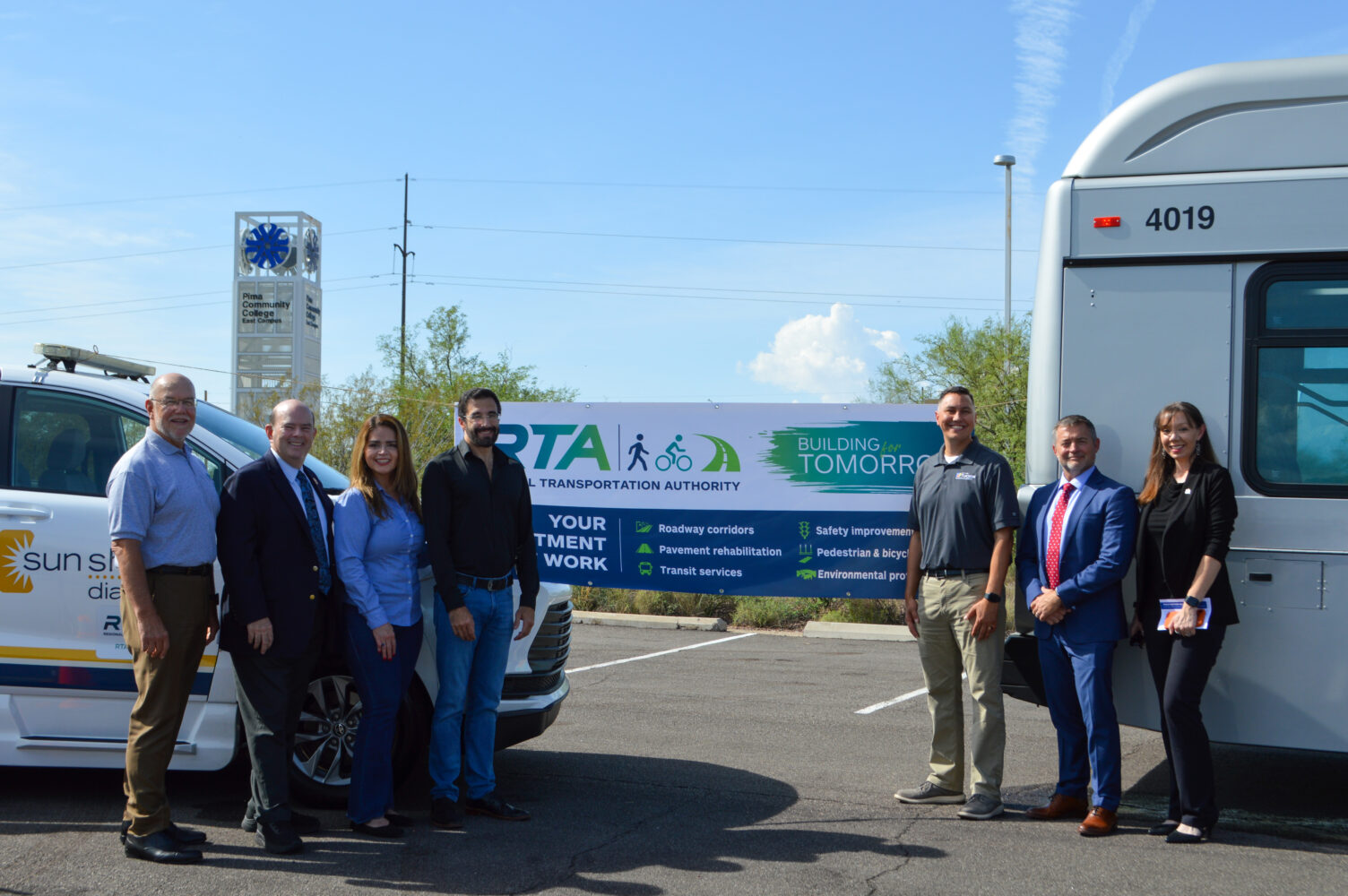
The event held at Pima Community College East Campus marked the inaugural project of the new RTA plan (RTA Next) and the first in the pavement rehabilitation element of the plan. Pavement rehabilitation was included as a new element in the plan and Irvington Road between Houghton and Kolb roads is the first roadway that will be fully repaved under the new RTA plan.
“In addition to building new roadways and supporting our regional transit system, community members told us that repairing and maintaining our existing roads is a top priority,” said Tucson Mayor Regina Romero. “My colleagues on the Council and I, along with the RTA Board, heard this message time and time again. That’s why we advocated for dedicating more than $177 million to repairing and improving major roadways throughout our region.”
RTA funding for pavement rehabilitation is reserved for the highly traveled arterial and collector roads across the region. Pavement reconstruction projects must have a design life that exceeds 10 years and include mandated ADA curb access ramp and other improvements. RTA jurisdictions will select the eligible roadways within their respective boundaries.
“This stretch of Irvington Road has been a challenge for many years, requiring constant maintenance when we knew what it really needed was to be completely rebuilt,” said Ward 4 Tucson City Council member Nikki Lee. “I’m incredibly grateful to the voters for choosing to invest in our roads and making this long-needed project possible.”
Pima County voters overwhelmingly approved the RTA plan in March. The ballot contained two questions for voter approval, Prop 418 to approve the plan and Prop 419 to approve the half-cent sales tax to fund the program for 20 years, both passed by roughly 60 percent.
The 20-year plan includes five elements:
- Roadway (multimodal) Corridor
- Pavement rehabilitation
- Transit
- Safety, ADA and Active Transportation
- Environmental
Funding breakdown:
- $1.4 billion (+$741 million in non-RTA funding) – Roadway (Multimodal) Corridors
- 31 corridor improvement projects including 4 freeway interchanges, roadway lane capacity enhancements, bus pullouts, bike lanes, pedestrian facilities, drainage improvements
- $257 million (+$237 million in non-RTA funding) – Roadway project modifications/completion; 7 projects from the 2006 Regional Transportation Authority plan have revised scope descriptions or funding needs that required voter approval
- $254.6 million – Safety, ADA and Active Transportation
- Intersection enhancement and modernization: Traffic signal technology upgrades, bikeways, sidewalks, greenways
- $177.6 million – Pavement Rehabilitation
- Curb-to-curb rehabilitation of regional roadway corridors
- $50 million – Environmental
- Wildlife linkages to reduce vehicle-animal collisions in highly traveled natural wildlife habitat areas
- $726 million (+$228 million in non-RTA funding) – Transit Expansions
- Expanded services: Weekend and evening bus service, increased bus frequency, paratransit/dial-a-ride, neighborhood shuttles to main bus system, express service to employment centers; high-capacity transit development, streetcar operations, safety and security of the regional transit system
Click for the 2026 RTA Plan Project list. Find information on RTA-funded projects in the City of Tucson here.
The new RTA plan will provide an estimated $125 million per year to be invested in regional transportation improvements, stretching the limited federal, state and local resources for regional projects.
The new plan will allow RTA funded-transit services in place for the past two decades to continue without interruption.
An economic analysis conducted while the plan was under development estimated the RTA investment in transportation would help support 48,000 additional jobs across the region over 20 years. This includes the short-term construction jobs to build the projects and long-term sustained jobs following improvements. The overall economic benefit of the plan is estimated at $3.7 billion over 20 years.